Of Time and Memory

Gilda Pervin
Of Time and Memory
October 5 - November 30, 2025
The city of Gilda Pervin’s childhood was a city of textures. “On a large scale, [Pittsburgh’s] roads and highways carved through the Allegheny Mountains. Visually this created walls of rock and stone,” she recalls. “On a smaller scale, I remember as a child, walking to and from school noticing the effects each season had on the painted brick and wooden houses. The paint was fresh in early Spring, then as the Summer wore on, the surface would bubble from moisture beneath; in Autumn the bubbles would crack, and through the Winter the soot in the Pittsburgh air would darken the edges of the cracks.” For Pervin, these early encounters with surface and change formed a vocabulary of transformation. “I do believe,” she says, “that the visual and tactile experiences of artists as children are often reflected in their work.”
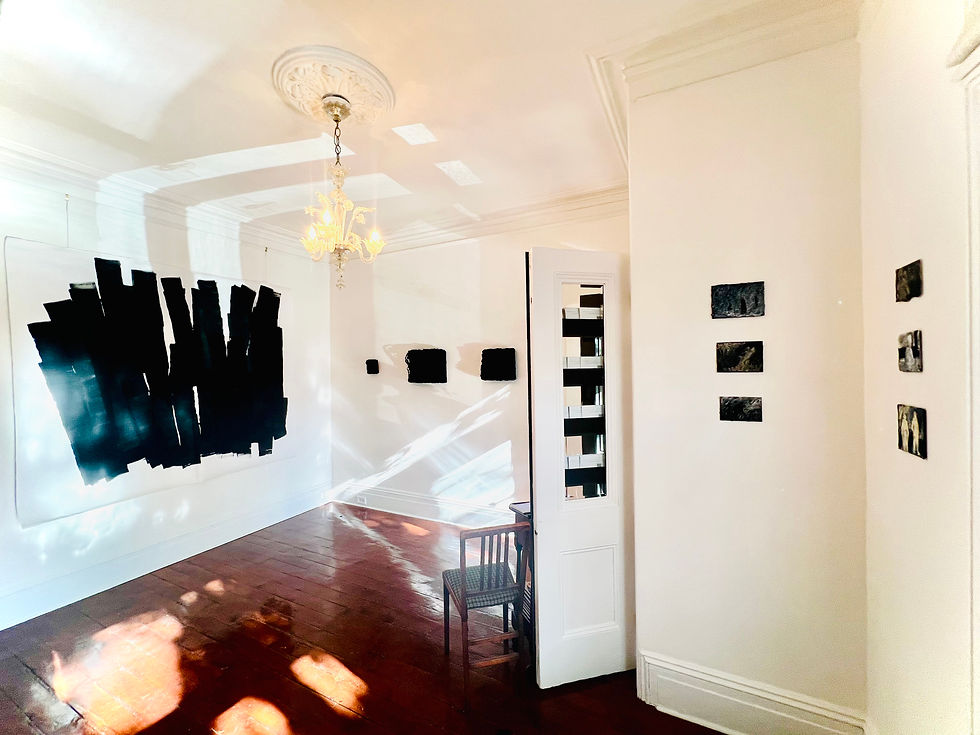
Over decades, Pervin has carried forward a deep engagement with material and texture. From cement—evoking the grit of her earliest architectural impressions—to humble found objects: grape stems, seed pods, plastic toy animals, glass or beads. Like Robert Rauschenberg, whose Combines blurred the distinction between art and life through the inclusion of everyday objects, Pervin embraces the histories embedded in matter. Each found object carries an origin, a texture, and a pattern that is inherent to it. Where Rauschenberg’s objects often retain their raw immediacy, Pervin’s are transformed, coated, and unified in the depth of black. Here she shares a kinship with Louise Nevelson, whose black assemblages harmonized disparate elements into sculptural wholes. For Pervin, black slows recognition: objects first read as line, form, and texture, camouflaging their source materials.
If found objects carry their own histories, Pervin’s black makes them newly anonymous and newly resonant. The sculptures hold what she calls “a moment, and a sense of memory.” Blackness unifies, transforming disparate elements into a whole and beckoning the viewer to linger, to arrive slowly at what the various media have become.
Pervin’s two-dimensional art is animated by the persistence of time. In describing her drawings and paintings of figures she notes “the snap of a moment” that contains within it past, present, and future. For her, the passage of time is inseparable from loss: “sometimes welcomed, sometimes mourned. And that to me is the human condition as we move from birth to death.” This frank clarity gives her work its emotional weight. Time, memory, transition—these are not abstractions but palpable presences.
Despite her classical training at the Pennsylvania Academy of the Fine Arts, which instilled compositional rigor she no longer consciously considers, Pervin finds inspiration in less expected places. She cites Agnes Martin, whose controlled, meditative grids and stripes at first seem distant from her own organic and intuitive forms. Yet Martin’s discipline and clarity resonate in Pervin’s work, where even dense materiality carries a sense of order. If Nevelson and Rauschenberg are her sculptural kin, Martin provides a counterpoint: restraint, quietude, and the discipline of repetition.
At ninety-one, Pervin continues to work with undiminished curiosity, imagination, and devotion to process. “I love the process—that’s why I am still doing it,” she says. Yet she acknowledges that the finished piece holds its own power: “the discoveries and surprises.” She describes the moment when a form suddenly appears, “perfect, and I have no idea how it got there.” Such moments suggest that making, for her, is a form of revelation—discovery beyond intention.
What she asks of the viewer is simple and direct: to notice. Whether positively or negatively, she wants the work to elicit feeling. And what remains with the viewer, as with the maker, is an awareness that the work is inseparable from the textures and experiences that have shaped her. Her art, she says with disarming candor, is “work that happens from being human and being alive—can’t argue with that.” ✦


Arthur Bruso and Raymond E. Mingst, curators
© 2025 Curious Matter, used with permission.
#gildapervin #oftimeandmemory #curiousmatter #arthurbruso #raymondemingst #josuhacharow #exhibition #fineart #contemporaryart


Comments